In connection with the agreed goals of the Green Deal and Fit For 55 protocols and with generally increasing demands for a significant reduction in greenhouse gas emissions and other pollutants from combustion engine exhausts, the Czech automaker Tatra responded by developing several HDV prototypes with alternative drives.
At the beginning of the significant pressure on so-called e-mobility, the management of the Kopřivnice automaker decided to follow the path of research and development of several prototypes of Tatra heavy trucks on FORCE model series chassis, each time with a different type of drive.
Hydrogen fuel cells
The first was created in 2022/2023, the Tatra FORCE e-Drive FCEV 8x6 (1+3, last axle controlled by the VSE system, FIRE-S cabin) with two Ballard hydrogen fuel cells (2 x 110 kW), a traction battery with Li NMC chemistry from EVC Group, with a capacity of 171 kWh and a plug-in system, a Danfoss electric motor with a continuous output of 480 kW (peak 580 kW) and 2 300 N.m of torque. The main transmission used was a robotic version of the Tatra 5TS 210 n with a Norgren electronic gearshift system. The total weight of the vehicle is 44 t or up to 62 t in a set. Within a few months, the vehicle was supplemented with a mobile hydrogen filling station in the form of an ISO container. Since then, the vehicle has been running in test operation and collecting a lot of very valuable information, for example from operation in very dusty traffic, where it is primarily intended as a construction or mining special.
Hybrid drive
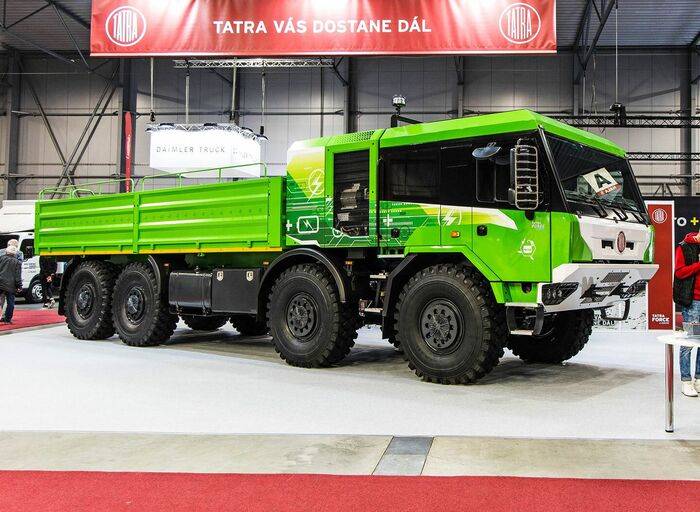
The second implemented solution was the Tatra FORCE e-Drive 8x8.1R with hybrid drive in 2024. In addition to the standard direct air-cooled IC Tatra T3 V8 RE Euro III engine, with a maximum power of 300 kW and a torque of 2100 N.m, the Force chassis was equipped with a Danfoss electric motor/generator with a continuous power of 300 kW (peak 500 kW) and an LTO traction battery with a capacity of 67 kWh.
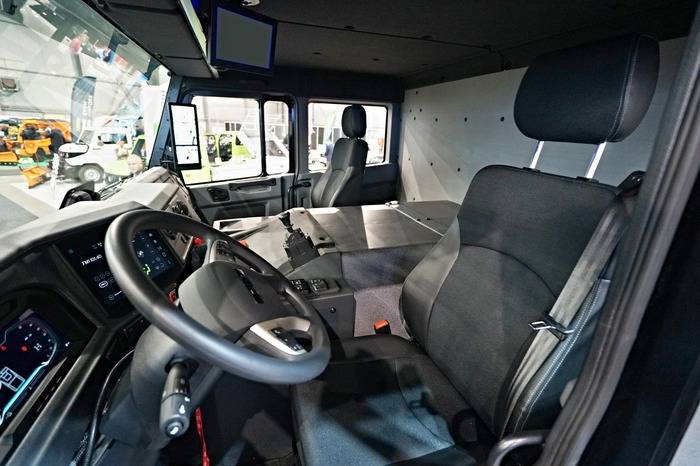
The main transmission is a seven-speed fully automatic Allison 4900. The four-door FORCE III cabin. The flatbed version and also the final colour (green, although sharp) suggest that this is a prototype that should be aimed at a military version in the future. Total weight 38 t, useful weight an interesting 22 t.
Fully electric drive
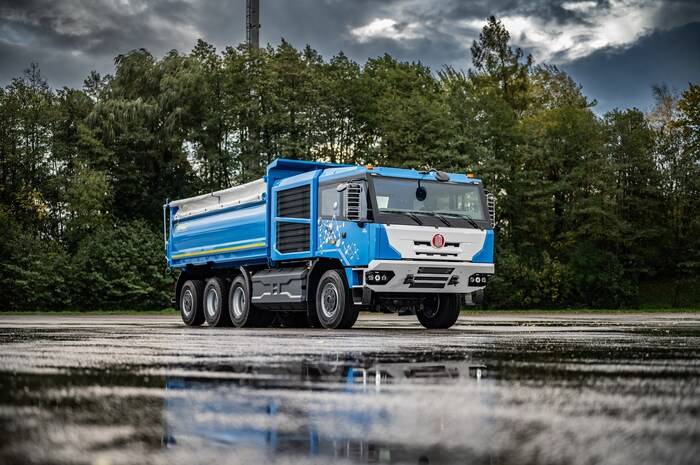
The third, and so far the last, prototype of the Tatra FORCE e-Drive series is a fully electric model. A two-door FIRE-S type cabin is placed on a four-axle chassis. Between it and the S1 tilting construction superstructure of the VS-Mont company, Webasto Pro 40 battery packs with a capacity of 480 kWh are placed (battery weight approx. 3 t, range approx. 300 km). The Danfoss traction electric motor with a continuous output of 330 kW (peak 550 kW) and a torque of around 2300 N.m drives the wheels of all axles via an automated four-speed Eaton gearbox and an additional/reduction Tatra drop-box. A small interesting feature beyond the prototype strategy is the Orlaco camera system replacing the system of exterior rear-view mirrors. The total weight can reach up to 44 t, of which a good half of the weight is useful. Total weight of the set up to 62 tons.
Will be ready
Czech Tatra cannot be "suspected" of preparing mass production of HDV with alternative drives, at least not in the near future. The reason for building undoubtedly very financially demanding prototypes is the need to be prepared for the future. What if it happens that interest, albeit drastically stimulated by terrible legislative or social measures, even among HDV customers increases from today's 1.5 percent (mainly distribution, regional and municipal transport) or 0.05 percent (construction and mining transport) to such a reasonable number? Tatra will have to have such solutions on offer. Thanks to the experience and knowledge it will gain from the development and operation of the above-mentioned prototypes, it will be able to respond effectively. Buy components or entire alternative drive trains smartly and relatively easily integrate them into typical chassis of the "Tatra concept".
Today it looks like a journey of individual, different steps, but the strategy is clear and from the perspective of a Tatra car manufacturer it is clever and smart.
Author: Milan Olšanský
Photo: Author, archive