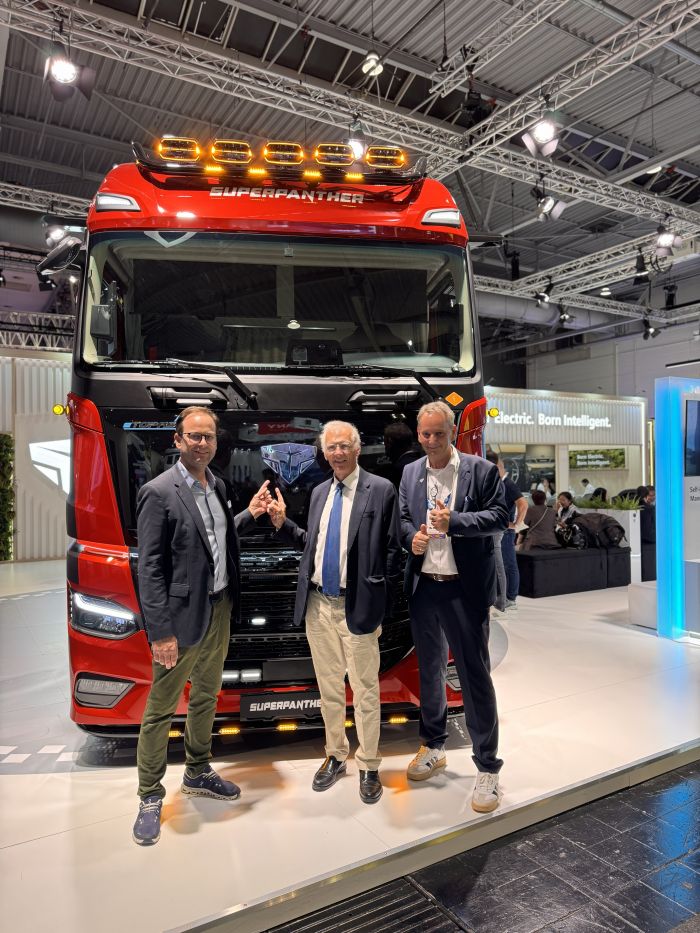
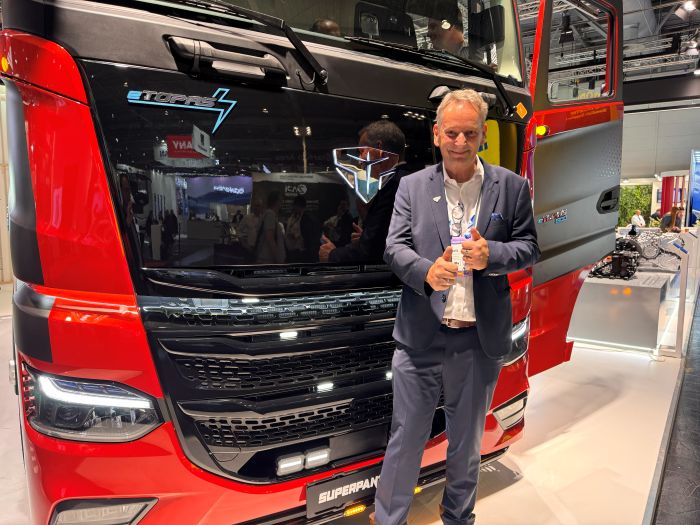
At IAA Transportation, SuperPanther is showcasing not only the current eTOPAS 600, but also technologies for the next generation. Frank Schulz, Head of Sales Europe at SuperPanther Co. Ltd, talks to the ITOY jury members Gianenrico Grifini and Florian Engel about 600 kW charging, vehicle-to-grid, a lighter e-axle, automated driving – and how the first vehicles are set to become the foundation of a European business.
Mr Schulz, we are standing in front of the SuperPanther Innovation Truck. What is the key message?
Much of what makes this eTruck valuable cannot be seen from the outside. The decisive elements are inside. That is why we are showing here what comes next in charging, thermal management, drivetrain technology and software.
Let’s start with charging. You talk about “CCS2 Plus”. What does that mean?
With a CCS2+ connector, we can transfer up to 600 kW. For this, the cable from the connector to the battery is liquid-cooled, as is the cable from the charging station to the CCS2+ connection in the eTOPAS 600. This is intended as an intermediate step on the way to MCS. The possibility of megawatt charging is already provided for on the left-hand side of the eTOPAS 600 Innovation Truck.
Can the current eTOPAS 600 also support dual charging?
Yes. Both CCS connections can be used simultaneously for “dual” charging. Under suitable conditions, we can achieve a combined charging power of up to 660 kW. This allows us to recharge the eTOPAS 600’s battery, with a total capacity of 621 kWh, almost completely during a 45-minute break. With one charge, we achieve a real-world range of up to 560 km, depending on driving style and environmental conditions, and even beyond that. Average electrical energy consumption is around 0.94 kWh/km.
And now you are going one step further – vehicle-to-grid?
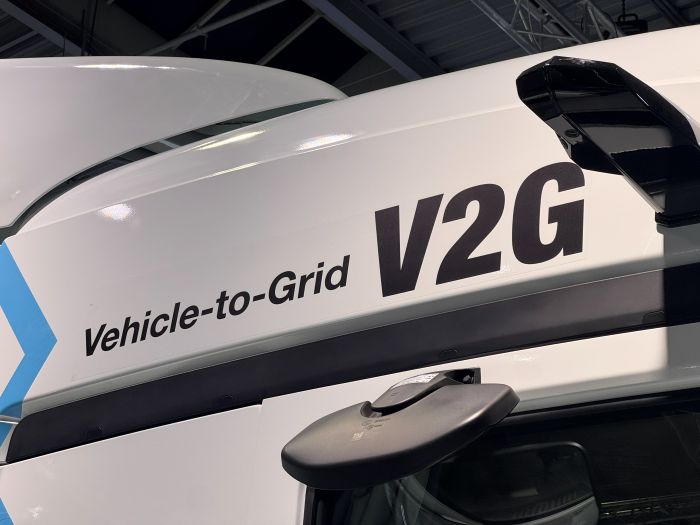
The Innovation Truck is prepared for this. In future, the idea is for energy not only to be taken up by the truck, but also to be made available again. For fleet management, the question may one day be: Should the truck be driving – or should it be making money while standing still? When electricity is cheap, the truck can be charged; when demand is high, it could feed energy back into the grid. The bidirectional charging and grid infrastructure required for this will become available in the future. Ultimately, this can also help support the stability of the electricity grid.
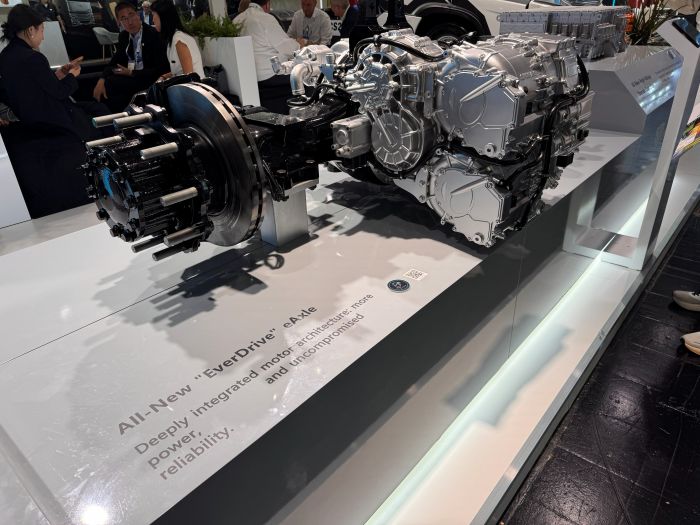
A second major topic you are showcasing is the new drivetrain
Our basic idea is that we want to develop the truck’s core products ourselves. If you control the core technology, you also control the pace of innovation and the product definition.
What is new about the new e-axle?
It is lighter and more compact. At the same time, we integrate two motors and a four-speed transmission.
Has the arrangement of the motors also changed?
Yes. With the new axle, both motors are positioned on the same side, creating additional installation space for an mPTO. This is very important to us because we receive many customer enquiries specifically for this hydraulic power take-off.
Is the high-voltage electronics system becoming more compact as well?
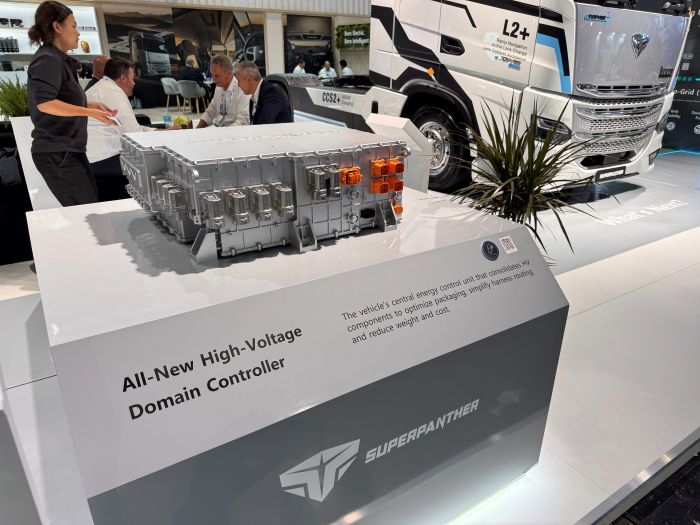
Yes. The new high-voltage domain controller combines power electronics, energy distribution and energy management. This significantly reduces both weight and installation space. The new e-axle and controller are intended for future vehicle generations and are still in series development, followed by validation.
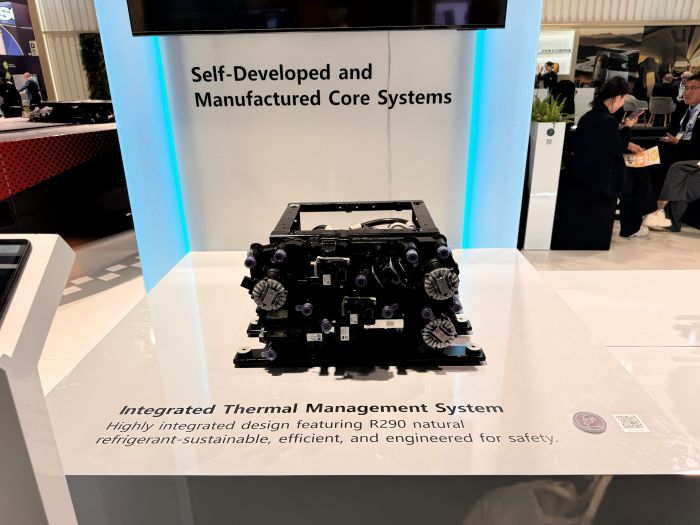
What is new in thermal management?
We are using an R290 heat pump. We have already achieved operation at temperatures down to minus 30 degrees Celsius. Particularly in Scandinavia or the Alpine region, it makes a major difference how efficiently you can heat the vehicle and condition the battery at very low temperatures.
What major development steps have you taken in software?
We also offer over-the-air updates and, if requested, can use vehicle data for predictive maintenance, all in accordance with European legislation. For us, it is not simply about saying: the truck has to go into the workshop on 10 June. We want to use sensor technology to determine the actual health condition of components before they are likely to fail.
How far do you want to go with automated driving?
The first step is Level 2 Plus. Among other things, the vehicle is intended to perform active lane changes and support the driver with lane guidance and collision avoidance. In the longer term, development will of course continue towards automated driving.
We summarise our broader software strategy under the term “Truck Brain”. This refers to an additional layer of intelligence above the real-time vehicle control system, intended to combine the transport task, vehicle condition, surroundings and external information. A separate coordination and safety layer checks these higher-level decisions.
For 2027, SuperPanther has specifically announced an L2+ highway pilot with active lane changes, in-lane collision avoidance and navigation at motorway entrances. Responsibility remains with the driver. To further develop intelligent trucks, we also signed an MoU with DHL at the IAA.
With all this technology, the red truck is nevertheless what catches the eye most at the stand.
Of course. For the trade show, we wanted to build something that would also appeal visually, with a special paint finish, black elements, graphics and additional lighting. There is room for something eye-catching at the IAA as well! Some of the lighting components fitted to the truck will not be available in this form in series production.
How broad is the eTOPAS portfolio already today?
It is deliberately customer-oriented. We offer a fully equipped specification as the basis, which can be customised with different tyres and cab colours, among other things. In addition, the ePTO power take-off is available as an option, for example for refrigerated semi-trailers, so that the diesel generator on the trailer can become a thing of the past. There are more things to come – many other features are already fitted as standard.
Including a 230-volt power socket?
Yes, with 2 kW of output. That was direct feedback from a driver. At the last IAA, he said to me: “Frank, we have more than 600 kWh of electrical energy in this truck and you can’t give me 230 volts for a coffee machine?” He was absolutely right.
So espresso and an air fryer in the truck?
If the driver wants that – yes. And I’ll be very happy to come by for the espresso. [laughs]
When it comes to components, are you deliberately relying on European suppliers as well?
Yes. For example, we use brake components from ZF WABCO, the steering comes from Schaeffler, the fifth wheel from Jost, and many, many other components come from European manufacturers. The tachograph, of course, comes from VDO. We make no compromises when it comes to quality and safety. That is also why we deliberately offer tyres from established manufacturers.
The truck nevertheless has Asian roots. What does production in Europe look like?
From the very beginning, we have been working with Steyr Automotive in Austria on the basis of an SKD process. Predefined assemblies are delivered to Steyr, where the vehicle is completed in accordance with Steyr Automotive’s quality processes, by technicians and engineers from Steyr.
How many markets are you currently serving?
SuperPanther already has vehicles operating in six countries: Germany, the Netherlands, Austria, Switzerland, Poland and the Czech Republic. Further eTOPAS trucks have already been ordered, so we will very soon be represented in many additional European countries, with growing volumes.
Which countries will be your main focus in the near future?
In principle, we are looking from Portugal to Poland and from Norway down to Italy, Greece and Romania. In the first step, we are particularly interested in markets where long-haul transport plays a role and where the necessary charging infrastructure is already available or currently being developed.
More countries also mean you need a functioning service network
Absolutely. We work very closely and in a customer-oriented way with Alltrucks, with workshops operated by major customers and with regional partners. On top of that, we offer 24/7 service and have our own mobile specialists, whom we proudly call our “Flying Doctors”.
Especially during the ramp-up phase, it is important to be able to carry out smaller jobs directly on the vehicle instead of having to bring the entire truck into a workshop.
You are still in the middle of the ramp-up. What production volumes are you planning?
Like every start-up, we also began with serial number 01. This year, we want to reach around 80 to 90 eTOPAS 600 trucks. By the end of 2027, we would be very happy to be at several hundred units.
What does that mean for your sales structures?
We are expanding our team for the European markets step by step. At the same time, we are open to local partners. Someone in Italy knows their market, their customers and their culture better than we do. The same applies to other countries. If a partner knows the commercial vehicle industry and wants to work with us, this can and will become a win-win situation in the interests of our customers.
If we meet again at the next IAA, what should have happened by then?
Many, many satisfied customers who are reducing their costs with the eTOPAS 600 and operating successfully in the market. The success and satisfaction of our customers is the basis for SuperPanther’s resulting market share in Europe.
Personally, I would be very pleased if we could learn from our grandparents and great-grandparents, who began electrifying the railway in Switzerland as early as 1918. I would like us to follow that example, operate road freight transport fully electrically and already make use of the resulting financial benefits today – helping to increase our shared prosperity in Europe.